VAR Example Oil
by Professor Throckmorton
for Time Series Econometrics
W&M ECON 408
VAR
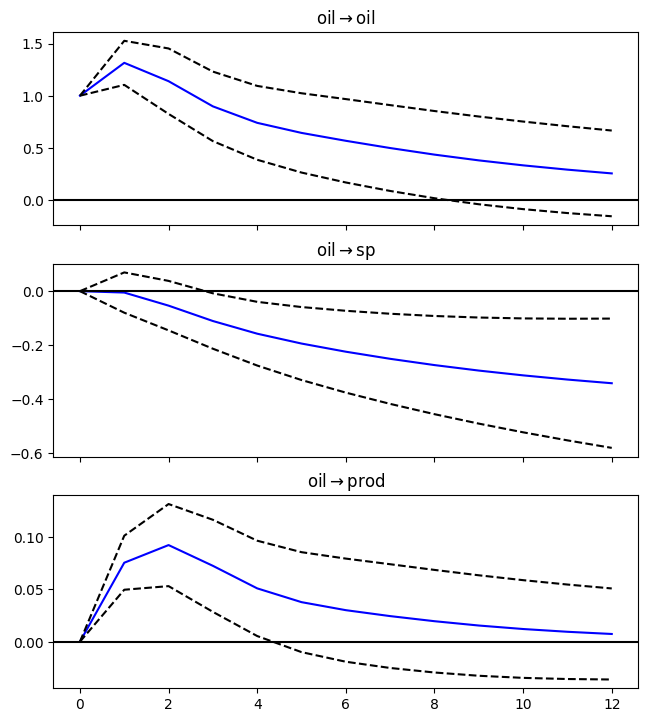
Big oil price increases are often associated with declines in production and asset prices. Read data on the price of crude oil (WTISPLC), industrial production (INDPRO), the S&P 500 (SP500), and the core consumer price index (CPILFESL).
# Libraries
from fredapi import Fred
import pandas as pd
# Setup access to FRED
fred_api_key = pd.read_csv('fred_api_key.txt', header=None).iloc[0,0]
fred = Fred(api_key=fred_api_key)
# Series to get
series = ['WTISPLC','INDPRO','SP500','CPILFESL']
rename = ['oil','prod','sp','price']
# Get and append data to list
dl = []
for idx, string in enumerate(series):
    var = fred.get_series(string).to_frame(name=rename[idx])
    dl.append(var)
    print(var.head(2)); print(var.tail(2))
oil
1946-01-01 1.17
1946-02-01 1.17
oil
2026-01-01 60.04
2026-02-01 64.51
prod
1919-01-01 4.8739
1919-02-01 4.6585
prod
2026-01-01 102.3963
2026-02-01 102.5510
sp
2016-03-24 2035.94
2016-03-25 NaN
sp
2026-03-20 6506.48
2026-03-23 6581.00
price
1957-01-01 28.5
1957-02-01 28.6
price
2026-01-01 332.793
2026-02-01 333.512
# Concatenate data to create data frame (time-series table)
raw = pd.concat(dl, axis=1).sort_index()
# Resample/reindex to quarterly frequency
raw = raw.resample('ME').mean().dropna()
# Display dataframe
display(raw)
/var/folders/dj/q2kc_rtn4kz50sd41yg6w8xc0000gq/T/ipykernel_36376/3185200006.py:2: Pandas4Warning: Sorting by default when concatenating all DatetimeIndex is deprecated. In the future, pandas will respect the default of `sort=False`. Specify `sort=True` or `sort=False` to silence this message. If you see this warnings when not directly calling concat, report a bug to pandas.
raw = pd.concat(dl, axis=1).sort_index()
Loading...
# Scientific computing
import numpy as np
data = pd.DataFrame()
# log real oil price
data['oil'] = 100*(np.log(raw['oil']/raw['price']))
# log real SP500
data['sp'] = 100*(np.log(raw['sp']/raw['price']))
# log industrial production
data['prod'] = 100*np.log(raw['prod'])
# Sample
#sample = data['03-01-2021':'02-28-2026']
sample = data
display(sample)
Loading...
# VAR model
from statsmodels.tsa.api import VAR
# make the VAR model
model = VAR(sample)

# Search over candidate lag lengths
lag_selection = model.select_order(maxlags=12)   # change 12 as needed
print(lag_selection.summary())

# BIC-selected lag
p = lag_selection.selected_orders['bic']
print("Selected lag by BIC:", p)
VAR Order Selection (* highlights the minimums)
==================================================
AIC BIC FPE HQIC
--------------------------------------------------
0 14.26 14.34 1.564e+06 14.29
1 7.932 8.232 2785. 8.053
2 7.417* 7.942* 1665.* 7.630*
3 7.517 8.266 1842. 7.821
4 7.662 8.636 2133. 8.057
5 7.774 8.973 2395. 8.260
6 7.846 9.270 2586. 8.424
7 7.889 9.538 2717. 8.558
8 7.971 9.844 2973. 8.730
9 7.962 10.06 2979. 8.812
10 7.997 10.32 3128. 8.939
11 8.006 10.55 3212. 9.039
12 8.094 10.87 3579. 9.218
--------------------------------------------------
Selected lag by BIC: 2
/Users/vultureview/venv/myst-env/lib/python3.12/site-packages/statsmodels/tsa/base/tsa_model.py:473: ValueWarning: A date index has been provided, but it has no associated frequency information and so will be ignored when e.g. forecasting.
  self._init_dates(dates, freq)
# Estimate VAR
results = model.fit(p)
# Assign impulse response functions (IRFs)
irf = results.irf(12)
# Plot IRFs
plt = irf.plot(orth=False,impulse='oil',figsize=(6.5,7.5));
plt.suptitle('');