Financial Markets
by Professor Throckmorton
for Intermediate Macro
W&M ECON 304
Slides
Summary
Define present value and arbitrage
Arbitrage equal expected returns, i.e., a financial market equilibrium
Define Yield-to-maturity and interpret the yield curve
Derive relationship between interest rates and stock prices
Present Value
Present value is the current worth of a future payment or stream of payments, discounted back using an appropriate interest rate to reflect the time value of money.
Applying present value allows us to price any asset, e.g., bond, stock, mortgage
Since present value depends on market expectations, current asset prices have information about expectations
| Today () | Next year () | in 2 years () |
|---|---|---|
Asset pays principal plus (expected) interest, compounding over time
Present value of received next year is discounted by
Present value of received in 2 years is discounted by
What’s important is to discount future cash flow according to when it’s received.
Recall a simple loan/one-period zero-coupon discount bond (e.g., T-Bill)
Current market price equals face value (future cash-flow) discounted to present by interest rate
is initial investment/loan given by market price, Face Value is known, this implies an interest rate, (a.k.a. yield to maturity)
Arbitrage
General use: buy thing at low price in one market and sell it at a higher price in a different market
For example, you could buy laptops for cash on college campuses and then list them on ebay at a higher price.
In finance, arbitrage refers to buying/selling assets depending on relative expected returns
For example, sell an asset with a high price/low expected return, then buy a different asset with low price/high expected return.
Goal: maximize expected return on a portfolio of assets
Portfolio Choice
Properties of bonds
Credit/default risk: who issued them and what’s the risk premium/spread?
Maturity: how long until bond pays face value?
Discount/Coupons: does bond also pay coupons?
Consider a small portfolio
Credit/default risk: bonds issued by U.S. government, so no default/credit risk
Maturity: either 1 or 2 years
1-year bond has price and pays in 1 year
2-year bond has price and pays in 2 years
Discount/Coupons: discount bonds only, no coupons, e.g., Treasury bills
2-year bond is transferable and could be sold after 1 year
Q: What is price of 2-year bond with 1-year left?
A: The price of a 1-year bond at that time.
Q: How do we manage this portfolio?
| Choice | This year () | Next year () | in 2 years () |
|---|---|---|---|
| A: Buy 1-year bond | — | ||
| B: Buy 2-year bond |
To compare cashflow next year, sell the 2-year bond next year at expected 1-year bond price, .
Divide by bond price to “invest” in each choice.
The return on worth of a 1-year bond is vs. the expected return on worth of a 2-year bond, which is
Goal: maximize expected return on portfolio
1-year bond return:
2-year bond expected return:
Three possible cases:
Disequilibrium (arbitrage opportunity):
sell 1-year () and buy 2-year ()
expected returns equalizeDisequilibrium (arbitrage opportunity):
buy 1-year () and sell 2-year ()
expected returns equalizeEquilibrium: (equal returns)
no incentive to rebalance portfolios
Cases 1) and 2) are arbitrage opportunities that lead to the equilibrium where there is no more arbitrage.
Equilibrium 2-year Bond Price
In equilibrium, 1-year return expected 2-yr return
Recall present value formula for 1-year bond price
Combine those
Update 1-year bond price forward one year, take expectation
Substitute that into 2-year bond price
This is the present value (i.e., asset pricing) formula for a 2-year discount bond.
Yield to Maturity/Curve
Yield to Maturity (YtM): the annual interest rate a bond holder receives if bond is held to maturity
I.e., YtM is the constant interest rate that equates current bond price with present value of all future cash-flow, e.g., for an -year discount bond,
where is -year YtM
We know and cash flow, so we can calculate all YtM
Yield Curve: a graph/table of YtM as function of maturity for bonds that have same credit/default risk, e.g., U.S. Treasuries
Combine bond market equilibrium with YtM definition
Since numerators are equal, then denominators are equal
Equation is nonlinear, so let’s linearize it! Recall
where is the natural logarithm
Take logs and use properties
2-year YtM is average of 1-year rates
Expected 1-year rate (predicted)
Expectations Hypothesis
Expectations hypothesis: the long-term rate is determined purely by current and future expected short-term rates
Since we can calculate YtM from current bond prices, the expectations hypothesis leads to a prediction about expected future short-term rates
E.g, if falls, then also falls
Q: When would actually decrease?
A: When the central bank sets a lower rate (in a recession).
Expectations hypothesis gives three cases for interpreting yield curve
Upward sloping:
, i.e., central bank expected to raise rate
bond market expects boom/expansionDownward sloping ({\color{red} i.e., inverted}):
, i.e., central bank expected to lower rate
bond market expects bust/recessionFlat (typically before recessions):
bond market expecting move from boom to bust
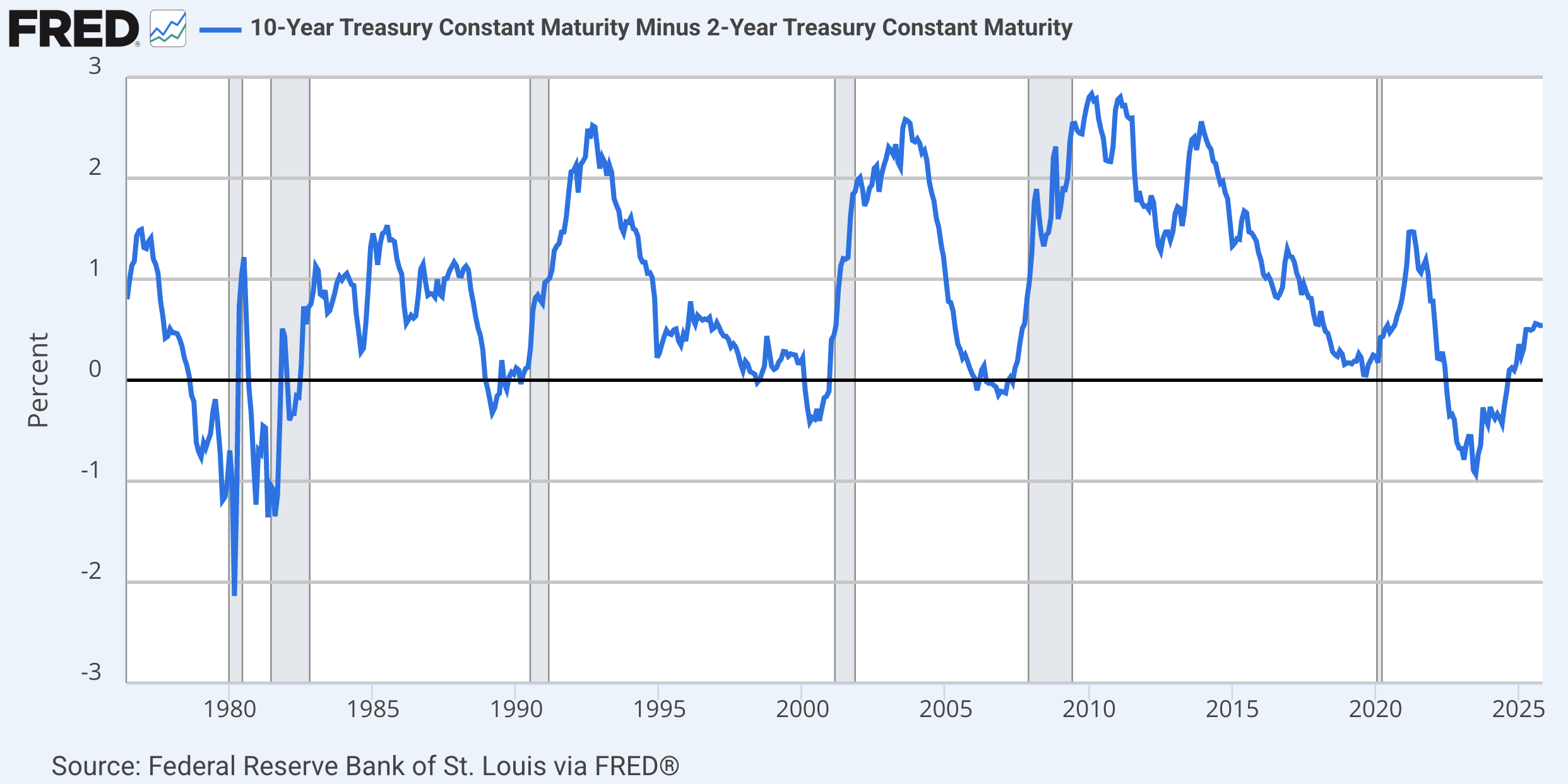
It’s usually upward sloping, but downward sloping ()before recessions?
10-Year Treasury Constant Maturity Minus 2-Year Treasury Constant Maturity (T10Y2Y)
Stock Market
Bonds and stocks both store wealth (i.e., they are substitutable)
New goal: maximize expected return on portfolio of 1-yr bond and a stock
Stock characteristics
- is current price
- is expected dividend (e.g., random, could be zero)
- is expected future priceQ: What’s the cash flow on a stock if you sell it after a year?
A: The expected dividend plus the expected sale price.
Portfolio Choice Problem
| Choice | ||
|---|---|---|
| A: Buy 1-yr bond | ||
| B: Buy stock |
Normalize
Time horizon year
Initial investment
is the risk premium, i.e., the additional return the portfolio manager wants to compensate them for the price risk of holding a stock
Goal: Maximize expected portfolio return
Disequilibrium (arbitrage opportunity):
1-yr bond return expected stock return
sell 1-yr bond () and buy stock ()
expected returns equalizeDisequilibrium (arbitrage opportunity):
1-yr bond return expected stock return
buy 1-yr bond () and sell stock ()
expected returns equalizeEquilibrium: 1-yr bond return expected stock return
no incentive to reallocate portfolio
(equal expected returns / no more arbitrage opportunties)
Stock Price
Assume equilibrium and solve for (with risk premium)
Update one period and take expectation
Substitute 2 into 1
This is a present value formula for a stock.
Fundamental Value
Keep substituting out expected stock price
As , PV of expected stock price goes to zero
Prediction: the fundamental value of a stock is just the present value of all future dividends (for a given risk premium)
Stock Price Summary
Arbitrage equal expected returns between a bond and stock (for a given risk premium)
Stock price is positively related to expected dividends, i.e., expected future profitability
Stock price is negatively related to (current or expected) short-term interest rates, e.g., news of higher future short-term interest rates lowers stock price
If managers become more risk averse, then stock prices fall.
The fundamental value of a stock is just the present value of all future dividends.